Navigating the global smartwatch and traditional horology supply chain requires deep technical oversight. As leading brand partners engineered over 5 Million+ wearable devices across 40+ global retail markets, China’s primary manufacturing hubs in Shenzhen, Dongguan, and Guangzhou represent 85% of worldwide watch strap production.
This whitepaper establishes rigorous OEM/ODM sourcing standards for procurement directors, product managers, and brand owners. We analyze Grade 5 Titanium CNC machining, FKM liquid silicone vulcanization, eco-certified leather tanning, and ISO 10993 biocompatibility compliance—equipping enterprise buyers to optimize lead times, eliminate defective yield rates, and maximize Information Gain across product cycles.
High-precision OEM/ODM watch straps engineered for traditional timepieces, smartwatches, and fitness trackers.
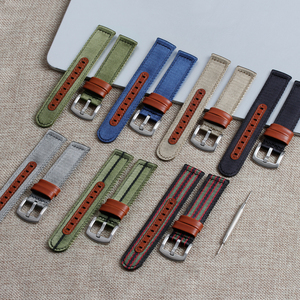
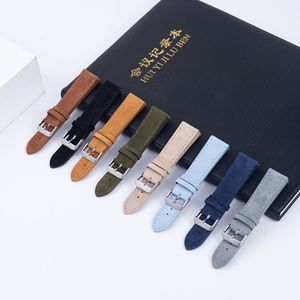
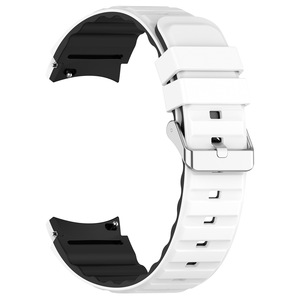
Key technical parameters required when selecting supply chain partners in Guangdong province.
Tier-1 Chinese factories utilize multi-cavity injection molds with beryllium copper inserts to guarantee rapid thermal dissipation. For silicone bands, automated LSR (Liquid Silicone Rubber) injection ensures zero air bubble entrapment and consistent Shore A hardness (typically 45° to 70°).
Sensory wearables demand direct skin contact safety. Leading producers enforce ISO 10993 cytotoxicity and sensitization testing. Thermoplastic Polyurethanes (TPU) and Fluorinated Elastomers (FKM) must undergo strict extraction testing to ensure zero phthalate migration or skin irritation.
Metal components (Titanium Grade 5 and 316L Stainless Steel) undergo Physical Vapor Deposition (PVD) vacuum plating. This yields scratch-resistant coatings (TiN, TiC, or DLC) capable of surviving 72-hour salt spray (ASTM B117) corrosion tests without oxidation.
Understanding the fundamental differences between material classes empowers purchasing departments to align target retail margins with technical durability. China’s watch band industrial clusters have specialized tooling architectures across four primary material pillars:
While standard silicone bands remain popular for entry-level smartwatches due to low raw material cost, enterprise fitness brands are rapidly transitioning to FKM (Fluoroelastomer). FKM exhibits superior resistance to human sebum, UV degradation, and extreme thermal fluctuations (-20°C to +200°C).
In manufacturing, FKM requires high-pressure compression molding at elevated curing temperatures (approx. 175°C to 190°C), followed by a secondary 4-hour oven post-curing cycle to stabilize polymer cross-linking. This process prevents dust attraction—a common drawback of untreated LSR bands.
Grade 5 Titanium provides an unmatched strength-to-weight ratio (45% lighter than stainless steel with higher tensile strength). Producing Titanium Milanese or metal link bracelets requires 5-axis CNC high-speed milling.
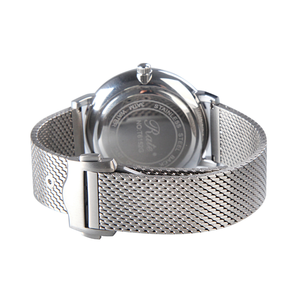
Because Titanium work-hardens rapidly, tooling speeds, coolant delivery, and carbide insert selection are critical. Advanced Chinese manufacturers utilize automated wire-mesh weaving looms for Milanese bands, followed by plasma micro-welding along the selvedge edges to ensure absolute structural integrity without snagging fine clothing.
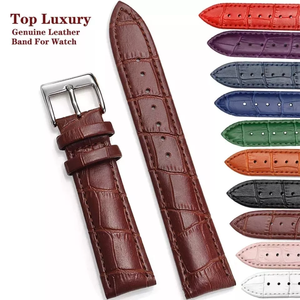
High-end leather strap production combines traditional artisan skiving with automated oil-edge painting. Top factories utilize Italian water-based edge paints applied in 3 to 5 successive coats, interspersed with automated infrared drying and mechanical sanding. This prevents edge splitting under repeated torsional stress.
Technical comparison of primary watch strap material classifications manufactured in China.
| Material Class | Tensile Strength | Shore Hardness | Corrosion / Chemical Resistance | Typical Lead Time | Target OEM MOQ |
|---|---|---|---|---|---|
| FKM Fluoroelastomer | 12 - 15 MPa | 65A - 75A | Exceptional (Oils, Sweat, UV) | 15 - 20 Days | 1,000 Pcs |
| Grade 5 Titanium (CNC) | 880 - 950 MPa | 36 HRC | Maximum (Saltwater Proof) | 25 - 35 Days | 500 Pcs |
| 316L Stainless Steel | 485 - 620 MPa | 217 HV | High (PVD Coated) | 20 - 30 Days | 500 Pcs |
| Full-Grain Calf Leather | 20 - 30 N/mm² | N/A (Soft-Milled) | Moderate (Requires Coating) | 18 - 25 Days | 500 Pcs |
| Ballistic Weave Nylon | > 2500 N | N/A (Flexible) | High (Quick-Drying) | 10 - 15 Days | 2,000 Pcs |
Building upon our established track record in smartwatch hardware, biometric sensor integration (PPG optical heart rate, SpO2 monitoring), and 5ATM water-resistant enclosure engineering, our partner facilities deliver end-to-end contract manufacturing.
Key shifts shaping China’s watch strap manufacturing landscape over the next five years.
Environmental, Social, and Governance (ESG) mandates are driving top consumer brands to replace ocean-bound plastics with bio-TPU derived from castor oil, as well as 100% GRS-certified recycled PET woven straps. Chinese factories are heavily investing in bio-based compounding lines.
As smartwatches shrink, manufacturers are embedding NFC, RFID, and flexible GPS antennas directly into multi-layer molded elastomer straps. Co-molding electronic circuitry within soft silicone requires strict thermal barrier engineering during vulcanization.
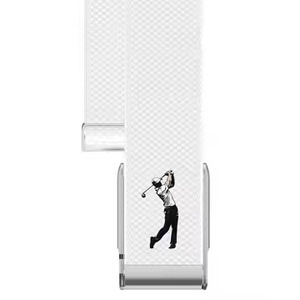
Direct-to-consumer (D2C) brands are leveraging automated short-run laser marking and UV inkjet printing directly at factory hubs in Dongguan. This allows low-MOQ personalized strap drops with 48-hour order-to-ship cycles.
Essential insights for global sourcing directors and supply chain managers.
Connect directly with our engineering team to review technical drawings, request material sample kits, or obtain competitive factory-direct quotations for your next product cycle.
Contact Us